

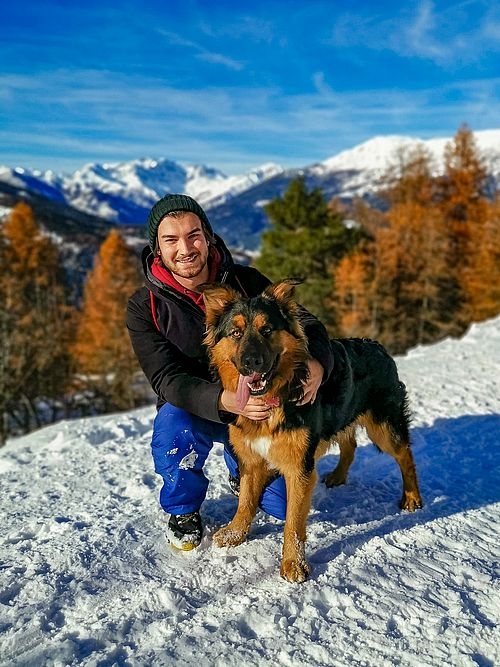
I’ve always been drawn to systems where life pushes against boundaries, like caves, glaciers, fractured alpine slopes: places where species survive under extreme conditions and where subtle environmental changes can have outsized consequences.
I’m currently a PhD student working on a joint project between the University of Bern and the University of Basel, focused on the conservation of high-alpine alluvial habitats released by glacial retreat. My research combines high-resolution terrain models, biodiversity data, and future climate scenarios to understand how these newly exposed ecosystems are structured, how species assemble across environmental gradients, and how we might protect them as the landscape continues to change. In practice, this means identifying and mapping emerging proglacial zones, tracking faunal communities, and projecting future ecological shifts to inform spatial planning and management strategies in the Swiss Alps.
I come from a background in Environmental Biology (University of Turin, Italy), where I first worked on subterranean ecosystems, exploring how groundwater-dependent fauna are shaped by both deep-time geological processes (like marine transgressions and glaciations) and current ecological drivers such as temperature variability and habitat heterogeneity.
Alongside my PhD, I contribute to the DarCo Biodiversa+ project, supporting the prioritization of fragmented subterranean habitats across Europe using Systematic Conservation Planning tools. I’m especially interested in how spatial data, trait-based ecology, and decision-support models can be combined to guide conservation efforts that are both effective and ecologically grounded.
I like staring at complexity in science and figuring out how to study it in ways that are rigorous but still respectful without losing the big picture. I mostly try to do that while engaging models, frameworks, and, unfortunately, parties and randomly starting philosophical conversations. When I’m not trying to untangle literature or troubleshoot field data, I enjoy socializing, playing music, photography, and chasing the ever-growing list of tools I want to learn next.