

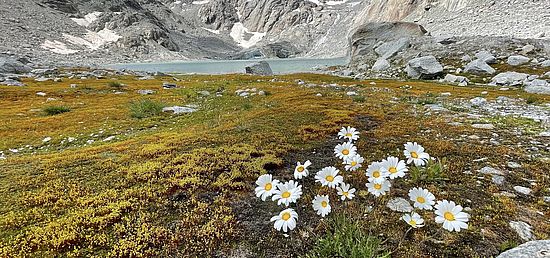
Conservation value of high alpine alluvial habitats
Gilles Hauser

Gilles Hauser

Gilles Hauser
The melting of glaciers linked to global warming will expose new ground that will be available for species colonization and development of new alpine habitats via natural succession. Glacier forelands are pristine areas that host a unique ecosystems and biodiversity
(e.g. high alpine alluvial habitat). However, the biodiversity of these habitats is understudied and at threat. In Switzerland, several projects of new hydropower installations or expansion of already existing infrastructure developed in the last years have targeted glacier forelands. The new Swiss energy law is also considering these areas as target for the expansion of solar energy projects.
In this project we seek to characterize, using a combination of field- based data and spatial modelling, what their biodiversity values of these areas are and whether these could be at risk because of changes in climate, management regimes and the potential of these new formed landscapes for infrastructure development. There is a specific focus of the project on arthropod communities and plants.
Key words: glacier forelands; biodiversity indicators; arthropods; climate change; renewable energy; occupancy modelling; microhabitat conditions
PI: Alejandra Morán-Ordóñez (University of Basel) / Raphäel Arlettaz (Conservation Biology, University of Bern).
Collaborators: Gianalberto Losapio (Biodiversity Change, Università de Milano and biodiversity Change group), Lisa Fisler (InfoFauna).
People: Leonardo Cruz da Sousa (PhD, University of Basel), Lorenzo Cresi (PhD, University of Basel), Jeanne Käser (MSc – University of Bern), Susanne Quaderer (MSc-University of Bern), Janine Hunziker (MSc – University of Bern), Rémy Desaules (MSc-University of Bern).